Haipeng Luo
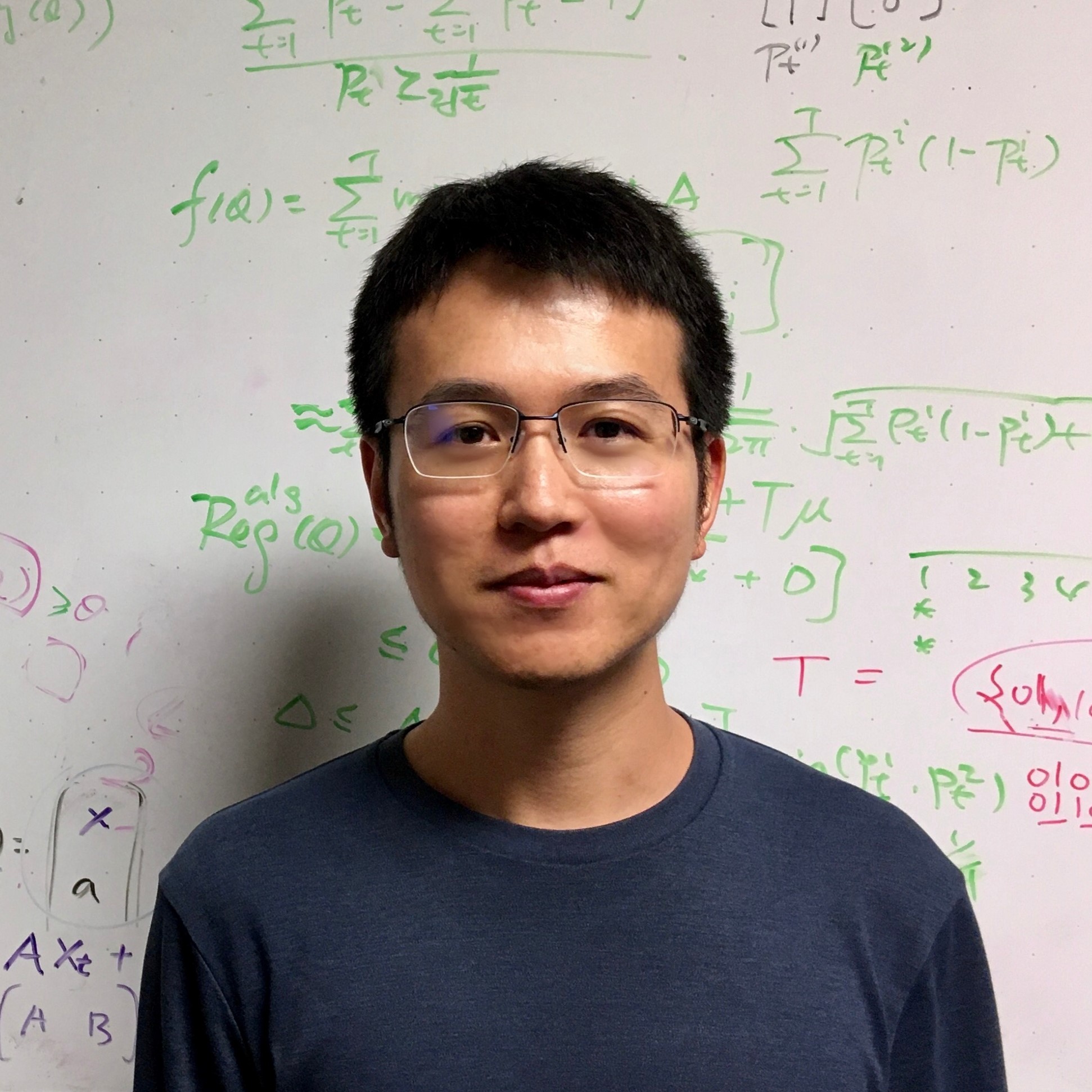 |
Associate Professor and IBM Early Career Chair Office: GCS 402N |
About me
I am an associate professor in the Thomas Lord Department of Computer Science at the University of Southern California. Previously I spent one year at Microsoft Research, NYC as a postdoctoral researcher. I obtained my PhD from Princeton University, where I was fortunate enough to be advised by Rob Schapire and also to work closely with Elad Hazan. I received my bachelor degree at Peking University working with Professor Zhen Xiao.
I was also previously a Google Visiting Faculty Researcher and an Amazon Visiting Academic.
Research summary
My research aims to develop the foundations of continually learning AI systems. I investigate how agents can acquire knowledge through sequential interaction, adapt to non-stationary or even adversarial environments, reason strategically about other agents, and make reliable decisions under uncertainty. My work combines reinforcement learning, online learning, game theory, and trustworthy machine learning to derive scalable principles and algorithms with rigorous guarantees. Recent contributions include advances in non-stationary and adversarial reinforcement learning, multi-agent learning, calibration and omniprediction, and learning dynamics in games. My long-term goal is to develop AI systems that can learn continuously from experience while remaining adaptive, trustworthy, and strategically robust in complex and evolving environments.
Research areas
online learning
bandit problems
reinforcement learning
multi-agent learning
calibration and omniprediction
Representative Papers
[NeurIPS 2025 Spotlight] Comparator-Adaptive Φ-Regret: Improved Bounds, Simpler Algorithms, and Applications to Games.
Soumita Hait, Ping Li, Haipeng Luo, and Mengxiao Zhang.
[NeurIPS 2025 Spotlight] Simultaneous Swap Regret Minimization via KL-Calibration.
Haipeng Luo, Spandan Senapati, and Vatsal Sharan.
[NeurIPS 2023] No-Regret Online Reinforcement Learning with Adversarial Losses and Transitions.
Tiancheng Jin, Junyan Liu, Chloé Rouyer, William Chang, Chen-Yu Wei, and Haipeng Luo.
[NeurIPS 2022] Near-Optimal No-Regret Learning for General Convex Games.
Gabriele Farina, Ioannis Anagnostides, Haipeng Luo, Chung-Wei Lee, Christian Kroer, and Tuomas Sandholm.
[COLT 2021 Best Paper Award] Non-stationary Reinforcement Learning without Prior Knowledge: An Optimal Black-box Approach.
Chen-Yu Wei and Haipeng Luo.
[NeurIPS 2021 Oral] The Best of Both Worlds: Stochastic and Adversarial Episodic MDPs with Unknown Transition.
Tiancheng Jin, Longbo Huang, and Haipeng Luo.
[NeurIPS 2020 Oral] Bias no more: high-probability data-dependent regret bounds for adversarial bandits and MDPs.
Chung-Wei Lee, Haipeng Luo, Chen-Yu Wei, and Mengxiao Zhang.
[COLT 2018 Best Student Paper Award] Logistic Regression: The Importance of Being Improper.
Dylan J. Foster, Satyen Kale, Haipeng Luo, Mehryar Mohri, and Karthik Sridharan.
[COLT 2018] More Adaptive Algorithms for Adversarial Bandits.
Chen-Yu Wei and Haipeng Luo.
[COLT 2017] Corralling a Band of Bandit Algorithms.
Alekh Agarwal, Haipeng Luo, Behnam Neyshabur, and Robert E. Schapire.
[NeurIPS 2015 Best Paper Award] Fast Convergence of Regularized Learning in Games.
Vasilis Syrgkanis, Alekh Agarwal, Haipeng Luo, and Robert E. Schapire.
[ICML 2015 Best Paper Award] Optimal and Adaptive Algorithms for Online Boosting.
Alina Beygelzimer, Satyen Kale, and Haipeng Luo.
[COLT 2015] Achieving All with No Parameters: AdaNormalHedge.
Haipeng Luo and Robert E. Schapire.